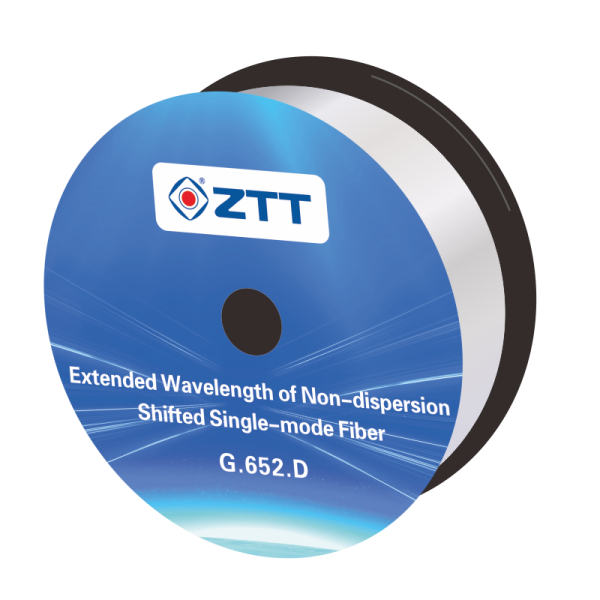
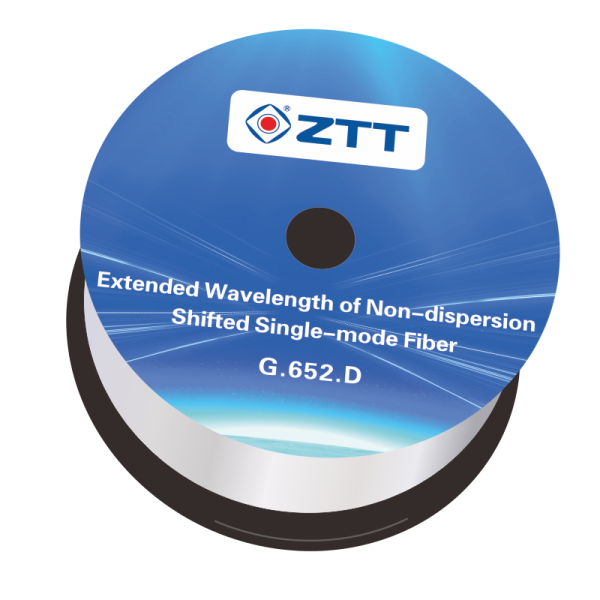
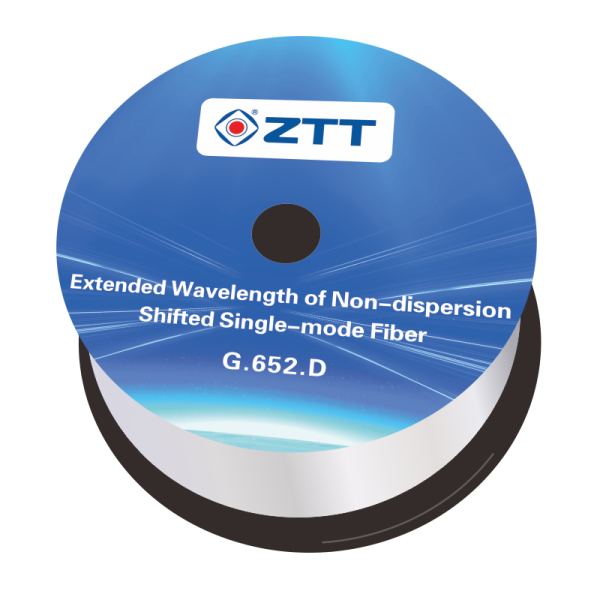
Extended Wavelength of Non-dispersion Shifted Single-mode Fiber (G.652.D)

ZTT extended wavelength of non-dispersion shifted single mode optical fiber adopts advance perform and drawing technique which reduces the water peak value at 1383nm. The fiber working wavelength extends to E wave band(1360nm-1460nm) to realize the full-wave transmission of O, E, S, C, L(1260nm-1625nm). Meanwhile, the innovated PMD rubbing equipment realizes the stable and good PMD coefficient when the high-speed production and it can meet the long distance and high-speed transmission.

Product  Details
  • ZTT optical fiber adopts advanced coating curing technique to provide good dynamic fatigue resistance property and increase the service life of optical fibers.
Description Specification
Attenuation (dB/km) 1310 nm ≤0.34
1550 nm ≤0.20
1625 nm ≤0.23
Zero Dispersion Wavelength (nm) 1312±12
Zero Dispersion Slope (ps/nm2∙km) ≤0.092
Dispersion Coefficient (ps/nm∙km) 1550 nm ≤18
1625 nm ≤22
PMD (ps/√km) Individual value ≤0.1
Typical value ≤0.04
Cable Cutoff Wavelength (nm) ≤1260
Macro-bending Loss (dB) (100circles,Ф50 mm)  1550 nm ≤ 0.05
(100circles,Ф50 mm)  1625 nm ≤ 0.10
Mode Field Diameter (μm) 1310 nm 9.2±0.4
Fiber Curl Radius (m) ≥4.0
Cladding Diameter (um) 125±1
Core/clad Concentricity Error (um) ≤0.6
Cladding Non-circularity (%) ≤1.0
Coating Diameter (um) 245±10
Clad / coating Concentricity Error (um) ≤12
Coating Non-circularity (%) ≤6.0
Proof Stress (%) ≥1.0
Tensile strength test (GPa) 15% Weber fracture probability 2.76
50% Weber fracture probability 3.45
Fatigue Resistance Parameter(Nd) ≥ 20
Peak Coating Strip Force (N) [1.3,8.9]
Temperature Cycling Induced Attenuation  (dB/km) ≤ 0.05
Damp Heat Aging Induced Attenuation (dB/km) ≤ 0.05
Heat Aging Induced Attenuation (dB/km) ≤ 0.05
Water Immersion Induced Attenuation (dB/km) ≤ 0.05

Applications

ZTT extended wavelength of non-dispersion shifted single mode optical fiber meets the conditions of backbone network, MAN, AN, submarine communication and power system test. The fiber is suitable for all kinds of cables, and the main structure is:

  • Optical fiber ribbon cable
  • FTTX cable
  • Central tube optical fiber cable
  • Tight buffer fiber cable
  • ADSS cable
  • Under water cable

Characteristics

  • Realizing O, E, S, C, L(1260nm-1625nm)full-wave transmission and increasing the transmission bandwidth
  • Choosing different coating material flexibly to meet different conditions.
  • Low PMD coefficient to meet high-speed transmission
  • Good dynamic fatigue resistance property is suitable for different conditions.

Let’s Build The Future with Innovation

Please provide the following details to help our sales representatives better understand your needs and get In touch with you as soon as possible.